Rodent activity inside residential crawlspaces and overhead framing poses severe structural and health hazards across Southern California. In older Spanish-tile bungalows in Silver Lake and Echo Park, roof rats (…
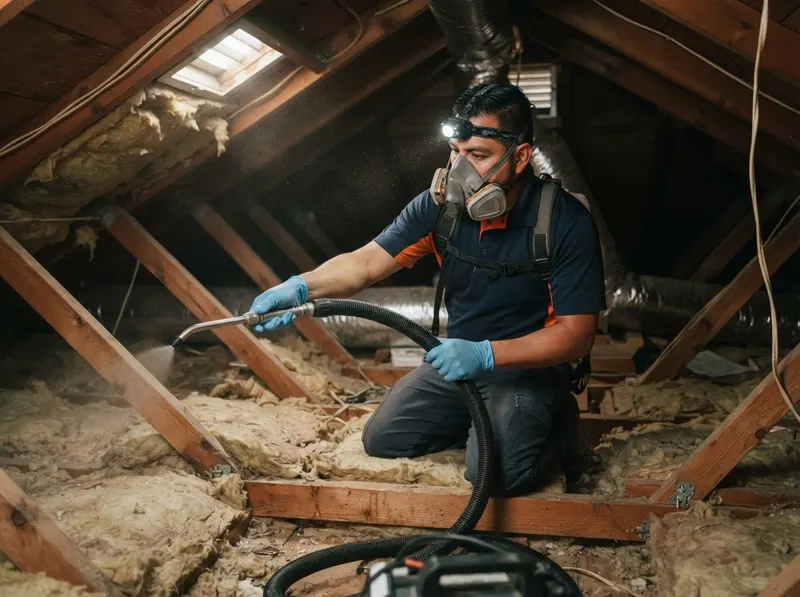
Rodent activity inside residential crawlspaces and overhead framing poses severe structural and health hazards across Southern California. In older Spanish-tile bungalows in Silver Lake and Echo Park, roof rats (California Department of Public Health vector monitoring records Rattus rattus as the dominant structural invader) enter via tile gaps and open eaves, depositing hundreds of biohazardous fecal pellets per week into loose fiberglass layers. This continuous biological buildup allows zoonotic agents, such as hantavirus pulmonary syndrome and lymphocytic choriomeningitis, to enter HVAC distribution ducts. ApexShield Pest Control treats the attic as a sealed envelope. Technicians deploy continuous negative-air pressure machines equipped with certified HEPA air filtration units operating at 99.97% efficiency at 0.3 microns, preventing toxic particulates from migrating into living areas during extraction.
Attic remediation requires clear decision parameters. When droppings are isolated to a single 10-foot perimeter chase in a Sherman Oaks or Woodland Hills ranch house, targeted localized vacuuming combined with spot biocide application is practical. However, when rodent urine has compromised blown-in cellulose insulation across 1,500 square feet, partial spot cleaning fails; embedded pheromones continuously attract new populations from nearby palm trees and telephone lines. Full thermal extraction combined with total envelope sanitation is mandatory in those widespread scenarios. Following extraction, ApexShield Pest Control applies broad-spectrum antimicrobials registered under the Federal Insecticide, Fungicide, and Rodenticide Act using ultra-low-volume cold fogging systems to penetrate wood pores, joists, and structural wall headers.
Structural safeguarding extends directly to thermal performance and electrical integrity. In neighborhoods like Brentwood and Los Feliz, unmonitored attic infestations frequently cause compromised electrical wiring; rats gnaw insulation sheathing down to bare copper, violating National Electrical Code safety standards and presenting continuous fire hazards. Technicians working within Los Angeles County verify framing stability and inspect electrical runs before deploying replacement material. Re-insulating with high-density materials compliant with California Title 24 Energy Standards restores structural R-values (typically R-30 to R-38 for local climates) while eliminating the thermal voids left by nesting rodents.
1. Technicians complete an initial 18-point structural attic diagnostic, logging moisture levels, access openings, and fecal density.
2. Negative-air equipment is ducted to outdoor exhaust zones while living areas are sealed using 6-mil poly sheeting.
3. Damaged insulation, droppings, and nesting debris are evacuated into sealed external containment drums via high-velocity extraction hoses.
4. Overhead structural framing receives a misting of non-staining, OSHA bloodborne pathogen-compliant enzymatic sanitizers.
5. Heavy-gauge galvanized 1/4-inch steel mesh exclusion barriers are permanently installed across eaves, dormers, and crawlspace louvers according to standards set by the National Pest Management Association.
Every job gets a firm, written price after a free on-site visit.
For standards, safe disposal, and service guidance on pest control services in Los Angeles, CA, useful references include U.S. EPA, ENERGY STAR, U.S. Dept. of Energy, Consumer.gov, U.S. Census Bureau, and Google Maps. General consumer and small-business resources are available from USA.gov, Better Business Bureau, FTC Consumer Advice, U.S. Small Business Administration, and Ready.gov.
Tell us about your attic decontamination and sanitation job in Los Angeles and we'll send a clear, written quote, usually the same day.
 ApexShield Pest Control